Help Explore Your Problem Deeper in This AI Era Where Any Solution Is One Prompt Away
Abstractly is an AI thinking tool for anyone who works with problems, from designers and PMs to founders, marketers and students. It works with the AI you already use, and helps you explore a problem deeper before jumping to solutions. I designed and built it as a side project to keep my own thinking sharp in the AI era.
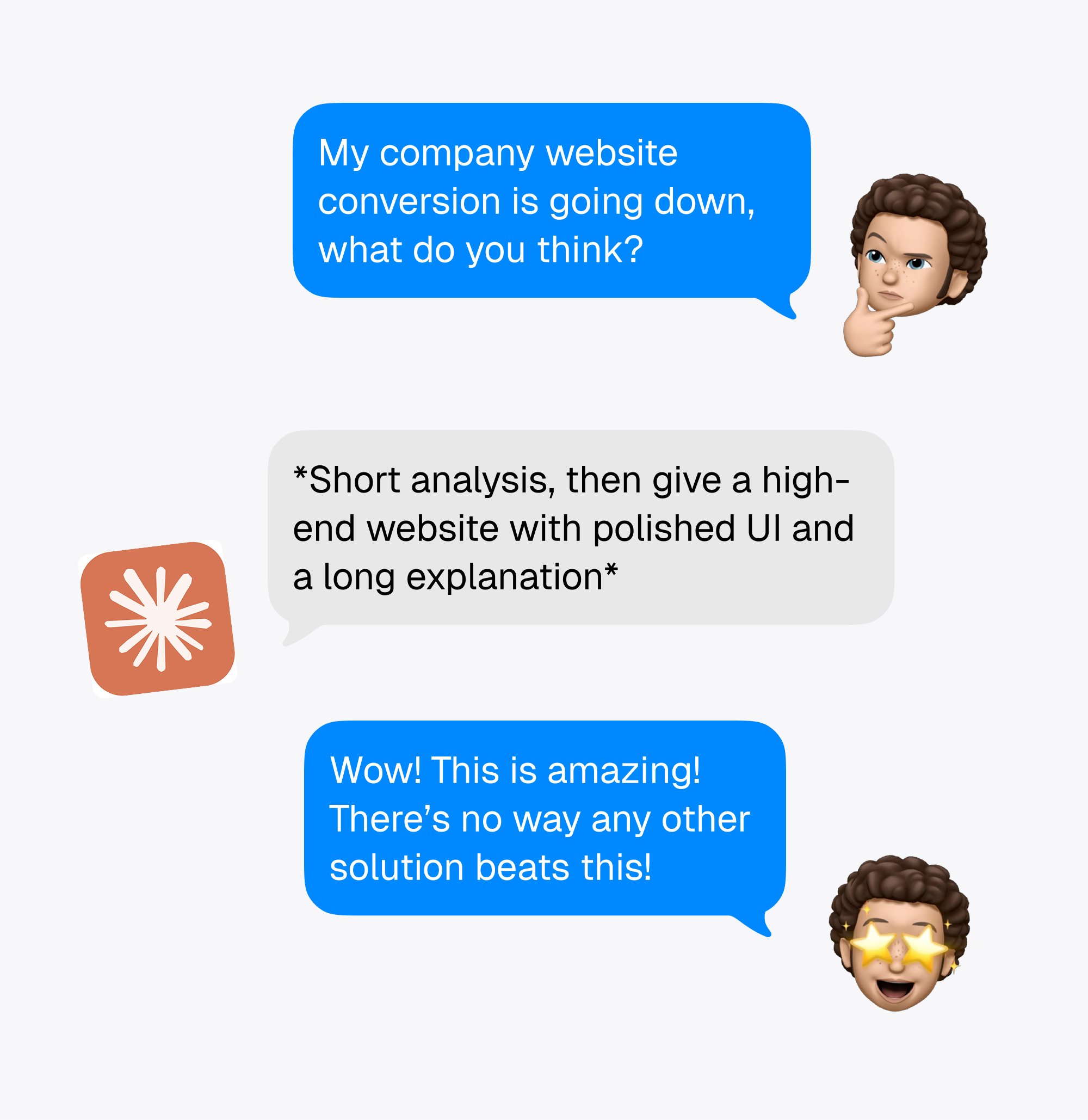
You have a problem on your plate
so you throw it to Claude

In seconds, it hands back an amazing solution
a clean flow, sharp copy, even a working prototype

You’re super happy with it
and pour all your energy into polishing the solution.

Until weeks later...
you realize you’ve been working on
the wrong problem this whole time

Time spent, effort wasted, back to square one
all because you didn’t spend enough time exploring the problem.

The faster we get answers, the less time we spend asking if it’s the right question.
We’re in an era where every problem can get a solution in seconds and a working build in minutes. Type a prompt, and AI hands back a business plan, a marketing strategy or a ready to ship app.
The output is so polished that it quietly convinces us, “This is already the best solution, isn’t it? No one can beat this.” And that’s exactly the trap.
This isn’t only a designer’s problem. Whether you’re a PM, founder, marketer, student or team lead, anyone who works with problems now gets a polished answer before fully understanding the question.
Drawn to the solution, blind to the problem
With all these capabilities, we’re drawn to solutions. We forget to look deeper, or wider, at the problem itself.
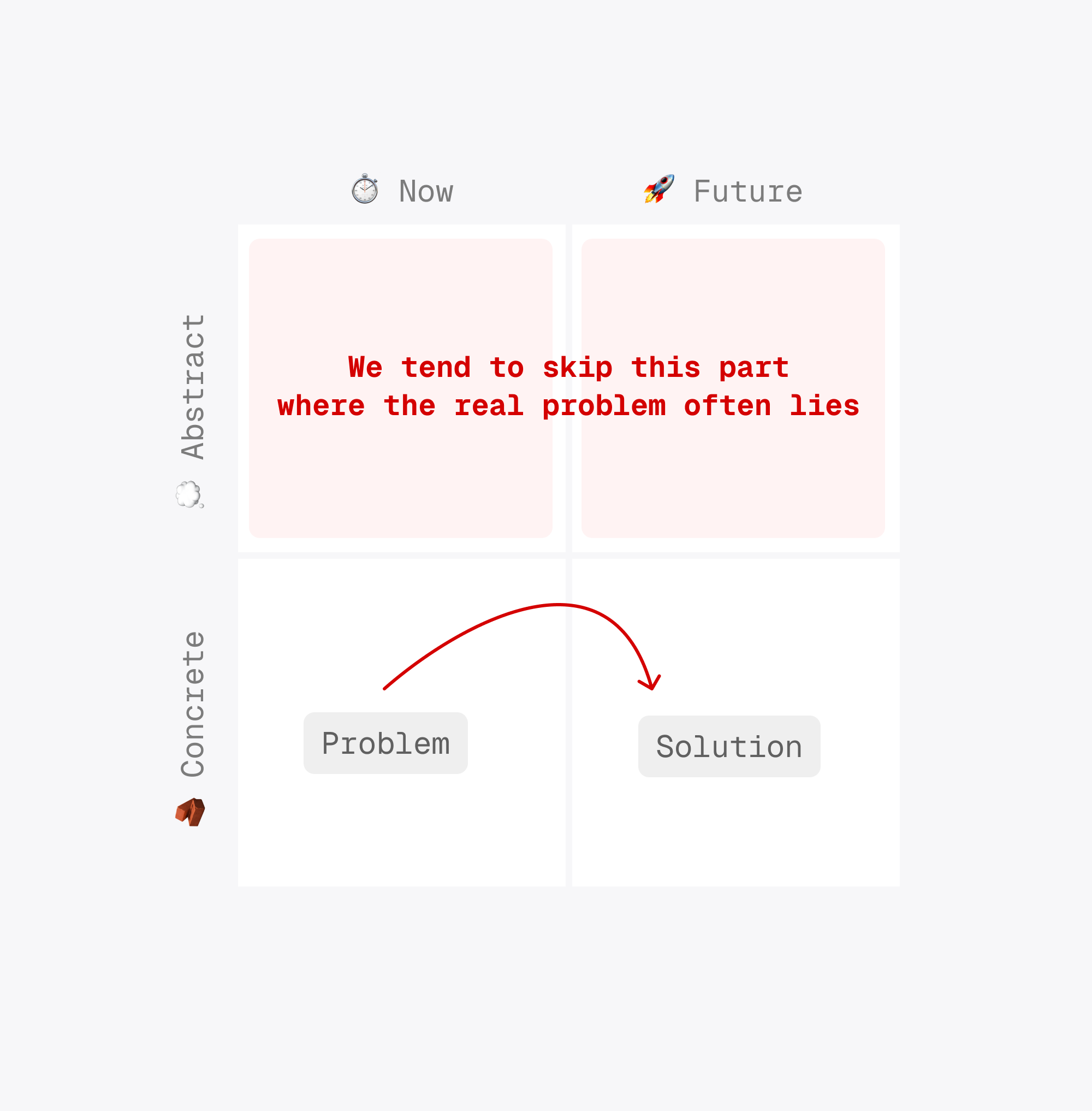
Hugh Dubberly’s bridge model explains this well. It’s a 2×2 grid, with columns moving from now to future and rows moving from concrete to abstract.
Most of the time we only move along the bottom row, from a concrete problem, such as a complaint, a report or a messy brief, straight to a concrete solution. We jump to solutions and forget to go up to the abstract row, where the real problem often lives.
How might we make it a habit to stop ourselves from jumping to solutions, and explore the problem deeper and wider before we build?
This is where the idea for Abstractly was born. I designed it to make pausing and questioning part of the process, helping you explore overlooked angles before committing to a solution.
 Abstract before concrete
Nothing goes from a problem straight to a screen without passing through “what does this mean?” first.
 Several answers, never one
Every reframe and every guess comes with rivals, so one confident AI answer can’t take over.
One engine, any LLM
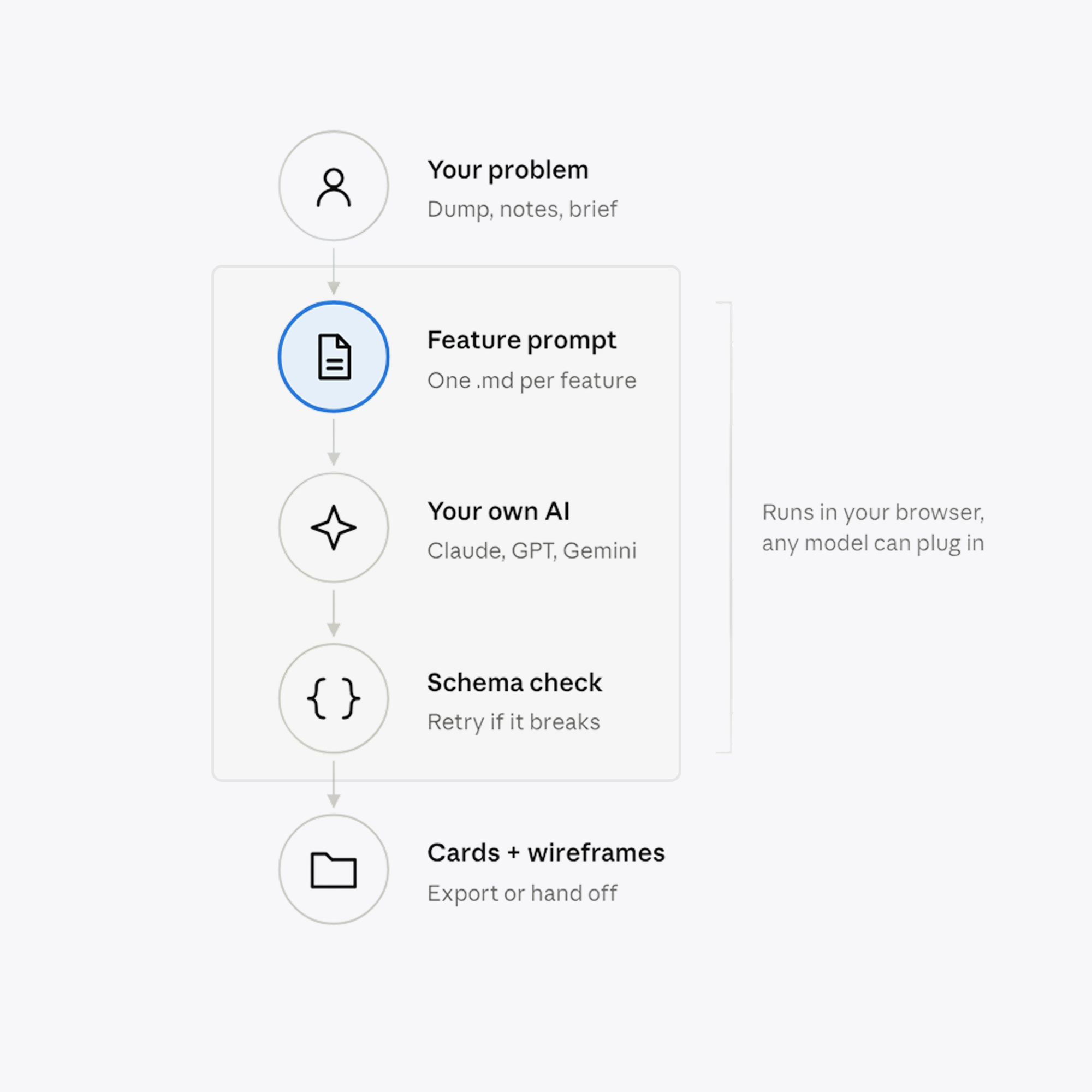
I built the mechanism to be simple, flexible and local. A browser-based pipeline connects reusable prompt files to the AI model you choose, checks each response against a shared schema and saves the results as plain files. This keeps the system easy to improve, lets you switch models and gives you control over your keys and work.
 Bring your own AI
Abstractly isn’t locked to one model. Connect Claude, GPT or Gemini through OpenRouter, or paste your own API key. Your tokens pay for your runs, so the tool itself costs $0 to run.
 Every feature is a prompt file
Reframe, Visualize, Wireframe and Reverse each have their own .md prompt. Improving a feature means editing and testing a file instead of rewriting code. Every output remembers which prompt version made it, so I can compare and roll back.
 A model adapter in between
The same prompt and schema go to any provider, so switching models doesn’t change how the tool behaves.
 Structured, not just chat
Each step returns JSON that must match a schema. If it doesn’t, it retries once, then shows what it has with a note.
 Private by default
Personal data is masked before any model call. The pipeline runs in your browser, and your keys stay there too.
 Plain files out
Everything saves as a .abstractly folder of Markdown and HTML, readable by people and by coding agents.
Four ways to stop and think
Each feature moves you to a different spot on the Dubberly map. Three go forward, one goes backward.
Explore the problem deeper
Dump your problem as it is, whether that’s messy notes, a brief, a report or just one sentence. Abstractly suggests framing lenses like zoom out, zoom in, flip, missing voice and what’s missing.
Each lens nudges you toward a blind spot you may not have discovered yet. A reframe must point to your own notes and name a specific shift, so you won’t get generic advice like “think about the user.”
Visualize your problem
Not quite getting it from a wall of text? Turn the problem into a map, a flow or a simple diagram in one click, something you can actually look at.
I used Answer me with HTML, the open public repository by @smk7z, as a foundation for this feature.
Generate approaches with different high level concepts
Once you’re convinced about the problem, generate several approaches with different high level concepts. Compare the core ideas before getting into screen details, so the conversation stays focused on how each approach solves the problem.
Each approach has to differ in its step order, level of guidance and who does the work, as well as its layout. These become the starting point before you build the polished solution.
Reverse engineer an existing solution
This one moves backward on the Dubberly map, from a finished feature in the concrete future up to abstract future and abstract now.
Drop in a competitor’s screens, or any product you admire, and explore the unseen reasoning behind their approach, the principles that shaped it and the bet they’re making. Every guess comes with a confidence level, so you know what’s inferred.
Exploring the abstract takes more than a tool
I know exploring the abstract isn’t as simple as choosing a lens or generating a few reframes. It takes context, judgment and the willingness to question your own assumptions. Abstractly can support that work, but it can’t do the thinking for you.
Still, it’s a good place to start. A small pause to look deeper, consider another angle and challenge the first answer can become a habit. That’s what I want Abstractly to help build, the habit of exploring the abstract before committing to the concrete.
The tool is still in early ideation. I’m refining the prompts and testing them against real problems to make that exploration more useful.
Here’s what I’m working on next.
- Tune the prompt files against a set of real problems, so reframes get sharper and less generic.
- Test with five people from different roles to see if it changes how they approach a problem.
- Ship the first slice of Reframe on pasted text, using your own AI.
The purpose stays the same. As AI moves faster, we can keep sharpening our minds by asking better questions, looking beyond the first answer and thinking more deeply about the problems worth solving.
- Hugh Dubberly, Shelley Evenson and Rick Robinson for the Analysis-Synthesis Bridge Model.
- @smk7z for Answer me with HTML, the open public repository I used to build Visualize.